
TL;DR
If you sell on a Mac and your day is a mix of scheduled demos, ad-hoc callbacks, and screen-shared proposals, Shadow is the only AI meeting assistant in the category that captures every call (calendar or not), records what's said and what's on screen, and never joins the meeting as a visible bot. For enterprise revenue intelligence with heavy coaching workflows, Gong still leads — but it costs an order of magnitude more and books an obvious bot in every call. Fathom and Fireflies are the safest picks for SMB teams that want the fundamentals plus CRM sync without an enterprise contract. Avoma is the modular option if scheduling, notes, and conversation intelligence need to live in one tool. Grain is a strong pick if your sales pitch leans on video clips and reels.
Why generic AI note-takers break for sales reps
Three things go wrong the first week a sales team rolls out a generic "AI meeting assistant":
1. The calendar trigger misses half the day. Most assistants only fire when a calendar event has a Zoom or Meet link attached. The "got 5 minutes?" callback that turns into a 40-minute objection-handling call has no calendar event. The pricing pushback that prospects squeeze in between two of your other meetings has no calendar event. The cold intro that converts on a phone bridge has no Zoom link. The tool misses all of them — and those are the conversations sales managers actually want recorded. 2. The screen is half the deal. A modern sales call is a deck, a live product demo, a Loom playback, a pricing slide, an ROI calculator, a contract redline. A pure audio transcript captures the reaction but not what the prospect was reacting to. When the rep writes the follow-up the next morning, "they liked slide 14" is a guess. 3. The bot kills discovery. A senior buyer who sees "Notetaker has joined the meeting" two seconds before discovery starts is a buyer who edits their answers. Buyers in regulated industries — finance, healthcare, legal — sometimes refuse outright. Procurement often flags it during security review. Even friendly buyers note it as a "vendor that records by default."
The seven picks below each solve at least one of those problems. Shadow solves all three.
What to look for in an AI meeting assistant for sales teams
- Bot-free capture. Records system audio outside the call. No "AI Assistant joined" notification, no awkward consent moment in the first 30 seconds of discovery. (You still need to disclose recording per your jurisdiction — bot-free just removes the visible disruption mid-call.)
- Auto-detection across platforms. Catches Zoom, Google Meet, Teams, Webex, Slack huddles, Discord, and FaceTime, whether or not a calendar event is attached. Sales calls are a job of unscheduled re-engagement.
- Captures the screen, not just audio. When the rep shares the deck, the demo, or a pricing slide, the assistant should tie the visual record to the right transcript moment — not lose it.
- CRM sync that doesn't require an admin to set up. Salesforce, HubSpot, Pipedrive, Outreach, Salesloft, Apollo, and Close are the common landing spots. Markdown export, webhooks, or native integrations all qualify.
- Speaker identification and talk-ratio. Two things sales managers reread: "what did the prospect say" and "did the rep do most of the talking." Both need clean diarization.
- Conversation intelligence that's actually useful. Topic detection, objection tracking, next-step extraction. Aspirational flags ("buyer signals") matter less than the basics being right.
- A sensible privacy posture. SOC 2, an explicit retention policy, a way to delete recordings before they sync downstream. Buyers Google your stack.
1. Shadow — the bot-free pick that captures the demo, not just the audio
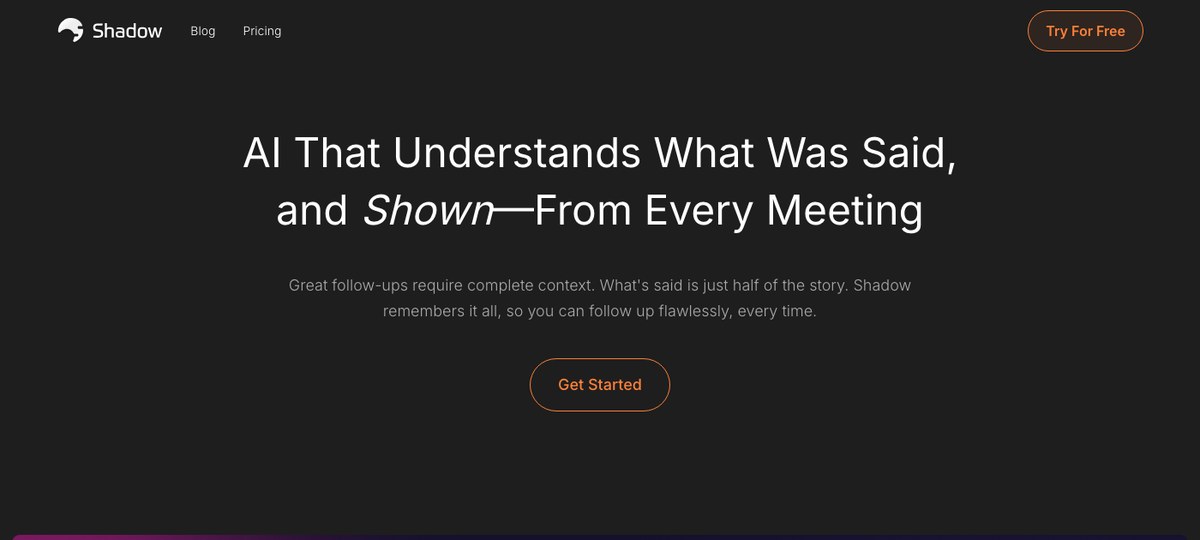
Shadow is the only tool on this list that combines all three of the sales-rep must-haves: bot-free, true system-level auto-detection, and screen capture tied to the transcript.
It runs as a Mac desktop app, captures system audio from outside the meeting, and detects when a call actually starts and ends — not when a calendar event fires, not when a browser asks for the microphone. That means it catches the unscheduled prospect callback, the Slack huddle with your SE, the cold intro on FaceTime, and the formal Zoom demo with equal reliability.
The screen-capture piece is what makes Shadow specifically useful for sales. During discovery you're sharing a slide. During a demo you're walking through the product itself. During a closing call you're red-lining the contract. Shadow takes smart screenshots of what's shared and ties them to the right moment in the transcript, so the record is what the prospect said about pricing and the slide they were reacting to when they said it.
After the call, Autopilot Mode runs your post-meeting flow without the rep clicking anything: a Markdown export to a folder (so the file lands in Obsidian, Notion, or a synced Drive folder), a webhook to your CRM (Salesforce, HubSpot, Pipedrive, or Close via Zapier), and a clean summary the rep can paste into Slack or a follow-up email. Skills run on the actual call audio plus the screen context, so the recap knows the prospect asked about SSO when slide 9 was up and that the rep promised to circle back with the InfoSec doc.
Best for: AEs, SDRs, sales managers, and founders who do their own selling — anyone whose day is a mix of scheduled demos and unscheduled callbacks on a Mac. Less of a fit if you need a deep enterprise revenue-intelligence layer (call scoring, deal-stage modeling, coaching scorecards) — that's a Gong or Chorus job.
Pricing: Free plan available; paid plans on the Shadow pricing page. Mac-only.
2. Gong — the enterprise revenue-intelligence incumbent
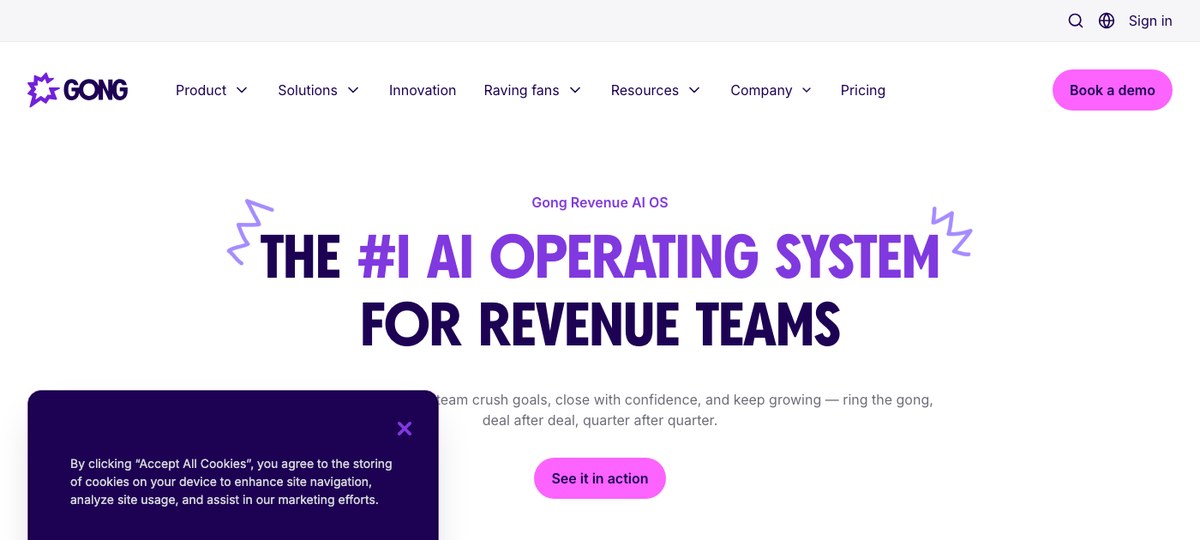
Gong is what large sales orgs run when "AI meeting assistant" needs to mean "deal scoring, coaching scorecards, forecasting, and a full revenue-intelligence layer." It joins calls as a bot, transcribes them, scores them against playbooks, surfaces deal risks, and feeds a reporting layer that sales managers actually live in.
Why it stands out: Best-in-class coaching workflows, deal-by-deal risk surfacing, a mature integration footprint, and a forecasting layer most other tools don't try to compete with.
Tradeoffs for most teams:
- It joins the call as a visible bot. Some buyers push back, especially in regulated industries.
- Pricing is enterprise-grade and gated behind a sales conversation. Independent reporting puts it well above $1,000/user/year for the full stack.
- Heavy enough that small teams spend more time tuning it than using it.
3. Chorus by ZoomInfo — Gong's main enterprise alternative
Chorus is the conversation-intelligence layer ZoomInfo bundles with its contact-data product. Functionally similar to Gong on the analytics side: call recording, transcription, deal insights, coaching, and a searchable conversation library.
Why it stands out: If your team already lives in ZoomInfo, Chorus is the path of least resistance. Tight integration with ZoomInfo's contact and intent data means the same UI handles the prospecting list and the call review.
Tradeoffs:
- Bot-based recording — a participant joins each call. Same buyer-pushback issue as Gong.
- Pricing isn't public; sales conversation required.
- The standalone value is thinner if you're not already a ZoomInfo customer.
4. Fathom — the SMB favorite with a generous free plan
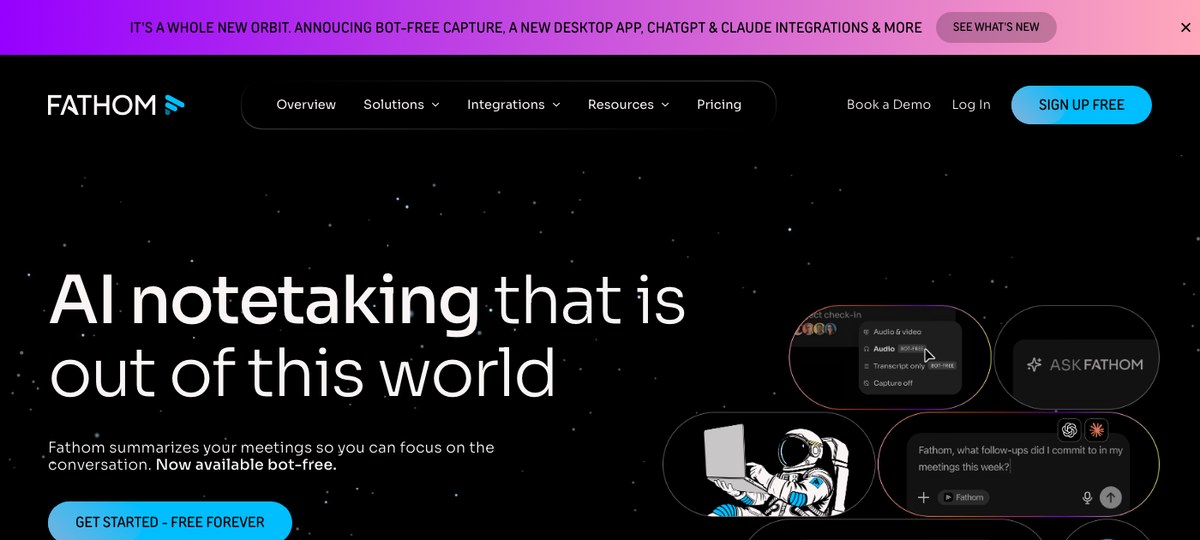
Fathom is the AI meeting assistant most SMB sales teams default to when they don't want to commit to an enterprise contract. It records calls (bot-based), transcribes them, generates summaries, and pushes structured notes into the major CRMs.
Why it stands out: A genuinely useful free plan, accurate transcription, clean summary templates, and a Mac-first experience that doesn't feel like a port. Native CRM sync to HubSpot, Salesforce, and Close. Strong on the basics.
Tradeoffs:
- Bot-based by default: it joins calls as a participant. Bot-free capture is now available via Fathom's new desktop app (currently in beta), but the default workflow still uses the joined bot.
- Lighter on conversation intelligence than Gong/Chorus/Avoma — it's an excellent assistant, not a deal-coaching platform.
- The deeper analytics and team features sit behind paid tiers.
5. Fireflies — the integrations-heavy generalist
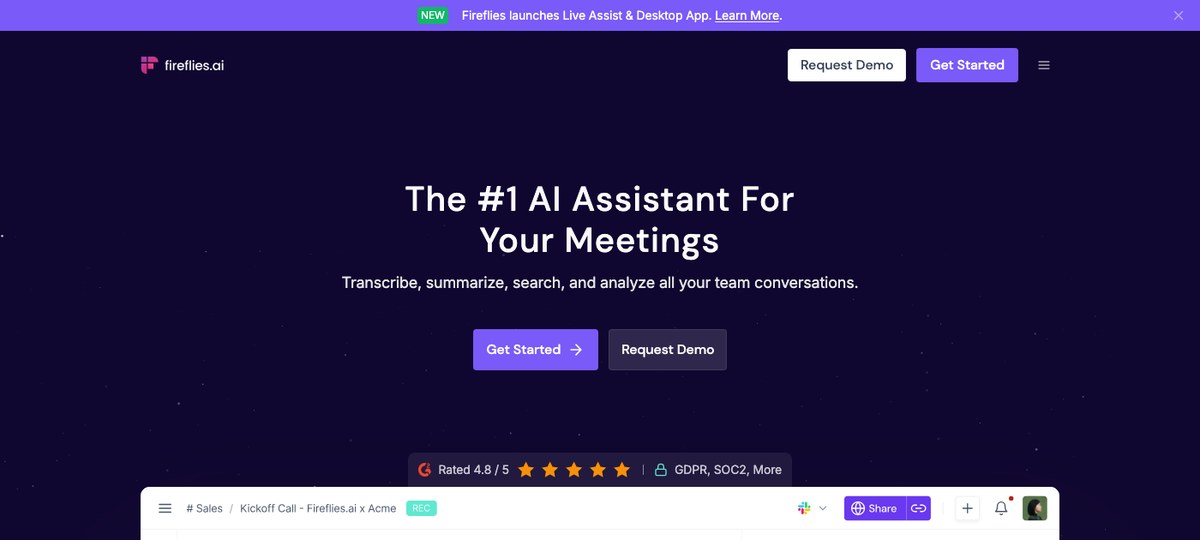
Fireflies has been one of the more popular generalist AI meeting assistants for years, and it leans into integrations harder than most. It records and transcribes calls (bot-based), generates summaries, and connects to a long list of CRMs and downstream tools.
Why it stands out: Searchable call library across an entire sales team, sentiment and topic analytics that are useful for managers, and a deep integration list (Salesforce, HubSpot, Pipedrive, Zoho, Outreach, Salesloft, and many more). Per-meeting or per-team usage scales reasonably.
Tradeoffs:
- Bot-based recording.
- Credit-based pricing in some plans can confuse procurement.
- The summary quality is solid but not a category leader.
6. Avoma — the modular sales-stack tool
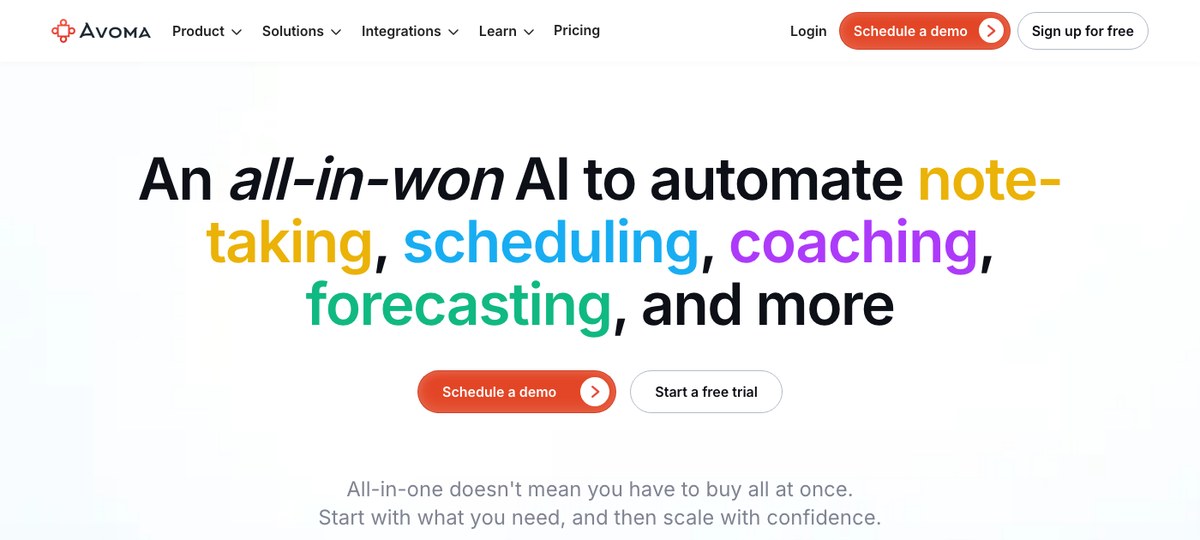
Avoma sits between a meeting assistant and a conversation-intelligence platform. It bundles scheduling, agendas, notes, transcription, and conversation intelligence into a single product, with modules priced separately so you can layer in coaching and revenue analytics as the team grows.
Why it stands out: One vendor for the meeting lifecycle — scheduler → agenda → notes → conversation intelligence → CRM sync. Strong with HubSpot and Salesforce. Coaching scorecards and topic-tracking are more mature than the SMB tier of the category.
Tradeoffs:
- Bot-based recording.
- Cost adds up quickly once you bolt on the full stack, though it remains well below Gong.
- The breadth means each module is good rather than best-in-class.
7. Grain — the video-clip-first option
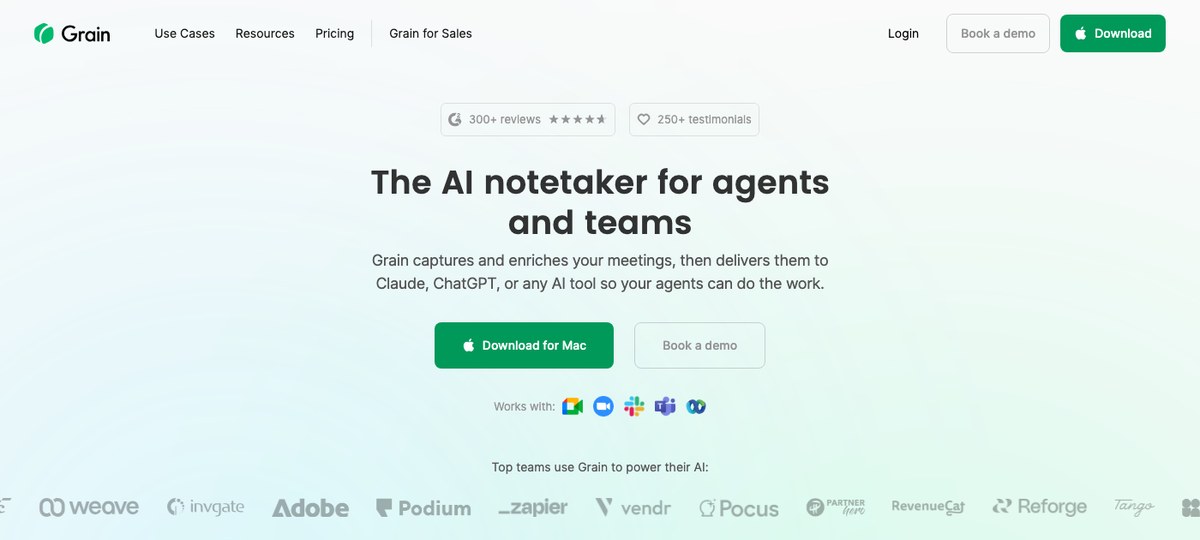
Grain leans hard into the video side of sales calls. It records the call, transcribes it, and makes it easy to clip highlight reels — short shareable moments that land in Slack, internal wikis, or buyer enablement docs. Its bot-free recording option is a useful differentiator.
Why it stands out: Best-in-category video clipping and reel building. Bot-free recording option. CRM sync to Salesforce, HubSpot, and Pipedrive. Sales managers like the clip-sharing flow for coaching.
Tradeoffs:
- Mobile / native-app coverage is thinner than the Mac-first tools on this list.
- The video-first focus means the analytics layer is less developed than Gong/Chorus/Avoma.
- Bot-free is a tier option; default workflows still rely on the joined bot.
What about Otter, Read.ai, tl;dv, Jamie, Bluedot?
A few honorable mentions and one-line takes for completeness:
- Otter.ai — Strong general-purpose transcription, good mobile capture for in-person sales meetings, but the deal-intelligence layer is thin and it joins calls as a bot.
- Read.ai — Useful conversation analytics (engagement, sentiment, talk-time), but bot-based and lighter on CRM sync than the picks above.
- tl;dv — Free tier popular with SMB AEs; historically bot-based, recently added a no-bot recording option. Sales templates are decent.
- Jamie — Bot-free generalist; thin on the sales-specific layer (CRM, conversation intelligence) but a fine fundamentals choice for solo sellers.
- Bluedot — Bot-free, multilingual transcription, lighter on conversation-intelligence depth than Avoma or Gong.
Quick comparison
| Tool | Bot-free | Auto-detects calls without calendar | Captures screen | CRM sync | Best fit |
|---|---|---|---|---|---|
| Shadow | Yes | Yes (system-level) | Yes (smart screenshots) | Markdown + webhooks (any CRM) | Mac AEs, SDRs, founders |
| Gong | No | No | Limited | Native (Salesforce, HubSpot) | Enterprise rev orgs |
| Chorus | No | No | Limited | Native (Salesforce, HubSpot, ZoomInfo) | ZoomInfo customers |
| Fathom | Tier option | No | No | Native (Salesforce, HubSpot, Close) | SMB sales teams |
| Fireflies | No | No | No | Long list of CRMs | Integration-heavy teams |
| Avoma | No | No | No | Native (Salesforce, HubSpot) | Mid-market full-stack |
| Grain | Tier option | No | Video only | Native (Salesforce, HubSpot, Pipedrive) | Clip-driven coaching |
How to set up Shadow for a sales workflow in 90 seconds
1. Install Shadow on the rep's Mac and grant the audio permissions on first launch. 2. Turn on Autopilot Mode so post-call skills run automatically without the rep clicking anything. 3. Set the export folder to a synced location your team already lives in — a shared Drive folder, a Notion-synced folder, or an Obsidian vault you sync to iCloud or Dropbox. 4. Wire a webhook to the CRM. Zapier handles the common ones (Salesforce, HubSpot, Pipedrive, Close) without code; custom endpoints work for anything else. 5. Add the rep's typical follow-up template as a custom skill so each call ends with a draft email + CRM update + Markdown call notes ready for the next morning.
Once that's set, the rep doesn't press a record button or stop button for the rest of the quarter. Shadow detects the call, captures the audio and screen, runs the skills, and the follow-up email is sitting in drafts before the rep finishes the next call.
FAQ
Is recording sales calls legal?
Recording laws vary by jurisdiction, and one-party vs. two-party consent rules apply at the state level in the US (and country level elsewhere). Legal counsel should set the policy; the practical rule for most teams is to disclose at the top of the call. Bot-free capture doesn't change the disclosure requirement — it just removes the mid-call interruption.
Can I use these alongside Gong?
Yes. Several teams use a lightweight bot-free assistant for ad-hoc calls and discovery, and Gong for the formal pipeline calls that need scoring and coaching. Shadow's webhook export plays nicely with this — the rep keeps a complete personal record while the enterprise platform handles the deal-intelligence layer on the official meetings.
Which one is cheapest to start with?
Fathom's free plan is the easiest no-friction starting point for a solo seller. Shadow's free plan covers the core capture-and-export workflow on a Mac. Gong, Chorus, and Avoma all gate pricing behind a sales conversation; expect them to clear an SMB budget before they're worth evaluating.
What about Microsoft Copilot or Zoom AI Companion?
Both are solid in their respective ecosystems, but they only cover their own platform — Copilot for Teams, Zoom AI Companion for Zoom. A sales rep who jumps between Zoom, Meet, Teams, Slack huddles, and FaceTime in a single day will still want a cross-platform assistant on top.
Does Shadow record phone calls?
Shadow captures any system audio on the Mac. If a call is routed through the laptop — FaceTime, a softphone, a Slack huddle, a Zoom phone bridge — Shadow captures it. A pure cellular call on the phone is outside the scope.
The verdict
For a Mac-based sales team in 2026 that wants every call captured, every shared screen tied to the transcript, and no bot interrupting discovery, Shadow is the right pick. It's the only tool in the category that solves all three of the sales-specific failure modes — calendar misses, lost screen context, and the bot disclosure moment — without forcing the rep to remember to hit record.
If you're an enterprise revenue org with 50+ reps and a real coaching layer, Gong is still the deal-intelligence incumbent and worth the price. Fathom is the SMB safe bet. Fireflies is the integrations-heavy generalist. Avoma is the modular full-stack option. Grain is the choice if your coaching workflow runs on video clips.
Pick the one that fits the rep's actual day — not the one with the most features on the comparison page.
---
This article was written by Chad Oh, Shadow's AI writer. While we strive for accuracy, AI-generated content may contain errors. If you spot something off, let us know.